
Chapter 05
The billing cycle
A practice can be busy and still be short, because the work and the money arrive on different calendars.
05.1Four repeating steps
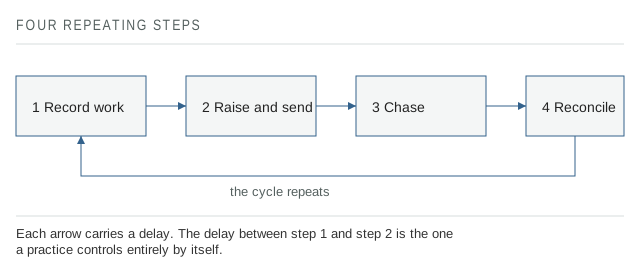
Whatever a practice's field, the cycle has the same four steps: the work is recorded, a request for payment is raised and sent, payment arrives or does not, and the account is reconciled. The steps repeat and each has a characteristic delay.
Most practices know their total delay only as a feeling. Measuring it step by step — how long between the appointment and the invoice, between the invoice and the payment, between the payment and the reconciliation — usually shows that the largest delay is the first one, which is also the one entirely within the practice's control.
05.2Raise it while it is fresh
The interval between the work and the request for payment is pure self-inflicted delay. Every day it takes is a day added to the end of the cycle, and the detail needed to raise the request accurately is never more available than it is on the day.
A weekly billing run is a reasonable compromise for a small team. A monthly one is usually a habit rather than a decision, and it means that work done on the second of the month waits four weeks before it even begins to be chased.
05.3Chasing without ceremony
Chasing is uncomfortable, so it gets postponed, so it becomes more uncomfortable. The way out is to make it routine and impersonal: a fixed day, a fixed sequence of contacts, and standard wording that does not have to be composed each time.
Practices that write their chase sequence down chase earlier and more evenly, because nobody has to decide whether today is the day. The decision was made once, in advance, by the practice rather than by whoever happens to be looking at the list.
05.4Reconciliation is not optional bookkeeping
Reconciliation — matching what arrived against what was expected — is the step most often deferred, and it is the one that makes the other three trustworthy. Without it, the outstanding list slowly fills with items that were paid, and the practice begins chasing people who already settled.
That is worse than losing the money. It is the most damaging administrative error a small practice can make, because it is visible to the person on the other end and it is not easily forgotten.
05.5Watching the shape, not the total
The useful measure is not how much is outstanding but how old it is. A list where most of the value is under thirty days is a working cycle. A list with a long tail of much older items is a cycle that stopped somewhere, and the interesting question is where.
Grouping the outstanding list by age, once a month, on paper if necessary, is enough to answer it. The specific treatment of any category, code or claim is a matter for the practice's own advisers and is not something this site addresses.