
How to Buy MOTS-c for Research: A Buyer's Checklist
A missing COA turns a peptide purchase into a gamble. Without per-batch purity data, your MOTS-c assay may measure contamination instead of mitochondrial biology. That risk sits with you, not the supplier.
This article walks through a practical MOTS-c buyer's checklist and applies it to Kovagen: independent per-batch testing, 7-panel COA documentation, shipping to the US and Canada, pricing, and batch traceability. By the end, you will know whether Kovagen fits your lab's sourcing requirements.
What Is Kovagen (KOVA)?
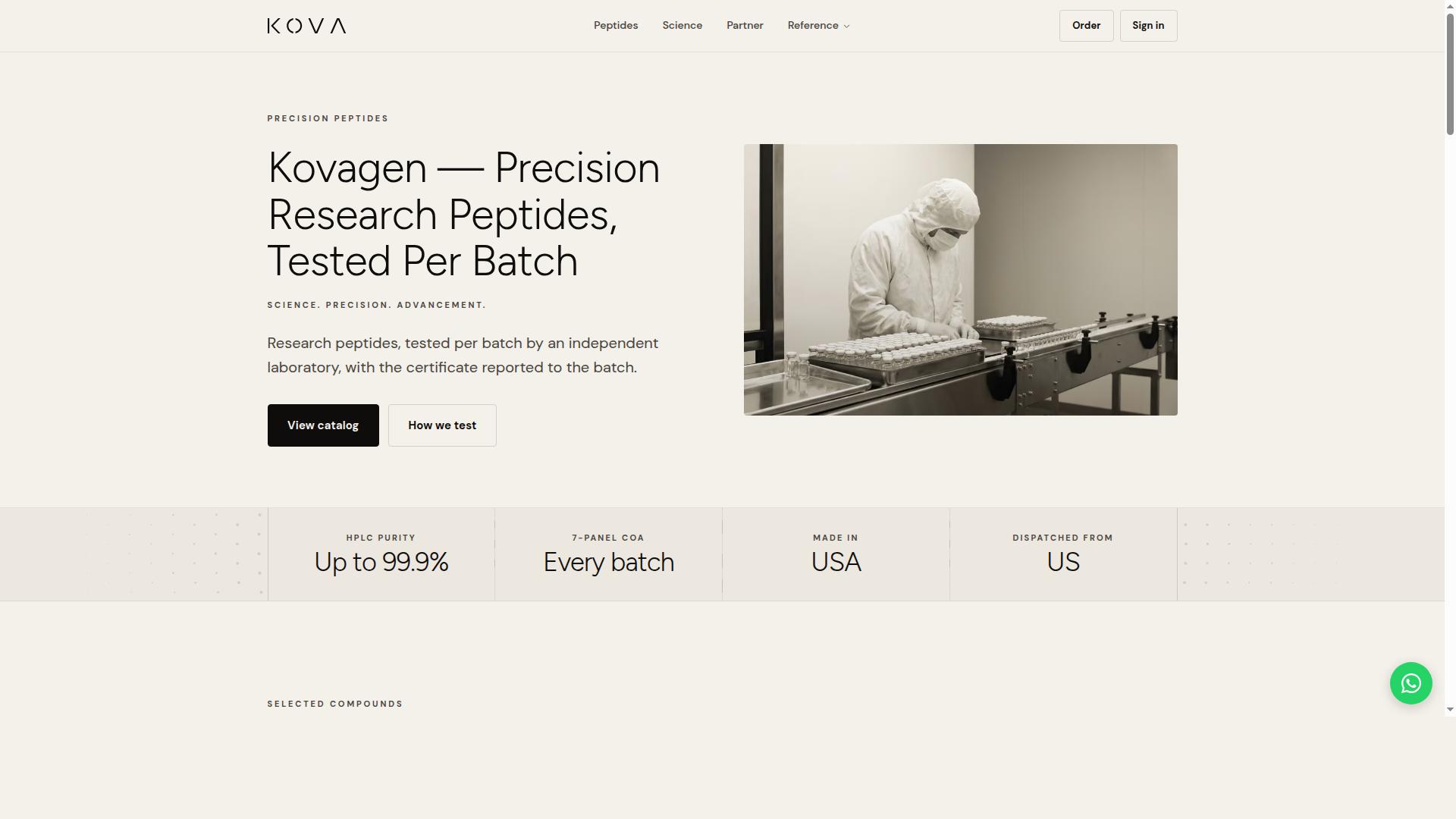
Kovagen (KOVA) is a research peptide supplier that ships to the United States and Canada, offering lyophilized peptides tested per batch by an independent analytical laboratory. The brand focuses on research peptides and research supplies, positioning itself squarely within the laboratory supply market rather than consumer health.
Behind the Kovagen storefront is its operating company, Hybrid Tech Rainbows LLC, based in Sheridan, Wyoming. That corporate identity matters for anyone running supplier verification, since it gives researchers a concrete entity to reference when checking business records or matching invoices to a vendor.
The brand summarizes its philosophy in a simple line: "Science. Precision. Advancement." Kovagen states that evidence is the product, a positioning that speaks directly to buyers who care about documentation as much as the vial itself.
One point deserves emphasis early. All Kovagen materials are supplied for laboratory research use only, not for human or veterinary consumption. That classification shapes how the brand presents its catalog: as research-grade peptide and laboratory reagent supply, intended for controlled experimental settings.
For the purposes of a MOTS-c buyer's checklist, Kovagen fits the profile of a peptide sourcing vendor whose claims rest on per-batch independent testing. Later sections examine how to verify those claims through documentation such as a certificate of analysis, so this overview stays at the level of identity and positioning. In short, Kovagen is a Wyoming-registered, North America-focused research peptide supplier that builds its reputation on testing transparency and a strict research-only stance.
Does Kovagen Meet the MOTS-c Buyer's Checklist?
To determine whether Kovagen meets a MOTS-c buyer's checklist, we evaluate three critical areas: independent testing and COA access, purity documentation, and shipping and service scope.
Each of these areas addresses a different risk in peptide sourcing. A MOTS-c researcher needs to know that the mitochondrial-derived peptide in the vial is what the label says it is, that the supporting data can be checked against a specific batch, and that the material arrives in a condition that preserves its integrity.
Testing matters because identity and purity cannot be judged by appearance. Documentation matters because reproducible in vitro studies and in vivo studies depend on knowing exactly what was in the vial, down to the batch. Shipping matters because a lyophilized powder is only as good as the handling it receives in transit.
The three checklist items below work through each area in turn, using Kovagen's stated practices as the reference point. Taken together, they give a buyer a practical framework for supplier verification rather than a vague impression of vendor reputation.
Checklist Item: Independent Per-Batch Testing and COA Access
Kovagen states that every batch is tested by an independent analytical laboratory, not in-house, and publishes certificates of analysis retrievable by batch number without an account.
Independent testing matters because a result produced by the party selling the product offers weaker assurance than one produced by a separate lab. For a research peptide used in metabolic research or aging research, the ability to trace a result to an outside laboratory is a meaningful part of supplier verification.
Per-batch testing is equally important. A single CoA covering a product line tells a researcher little about the vial in hand. When each batch carries its own certificate, batch traceability becomes possible, and a result can be matched to the material actually being used.
Open access to those documents removes another barrier. Kovagen publishes certificates per batch and lets buyers retrieve them by batch number without creating an account, so a laboratory reagent can be checked before purchase and again on arrival. That is a straightforward, verifiable step any buyer can take.
Checklist Item: Purity Documentation and 7-Panel COA
Kovagen reports HPLC purity up to 99.9% and provides a 7-panel certificate of analysis.
A multi-panel CoA gives a fuller picture than a purity figure alone. Typical panels in this category cover several complementary checks:
- HPLC purity, which estimates how much of the sample is the target peptide versus related impurities.
- Mass spectrometry, which confirms the molecular mass matches the expected structure.
- Peptide sequence confirmation, which verifies the amino acid sequence is correct.
- Endotoxin testing, which matters for work where endotoxin contamination could confound results.
- Sterility testing, which indicates whether the material is free of microbial contamination.
For MOTS-c, a mitochondrial-derived peptide studied in cellular metabolism and AMPK activation work, these checks reduce the chance that an unexpected impurity or a sequence error skews an experiment. Sequence confirmation in particular separates a verified peptide from an assumed one.
Kovagen makes these panels available per batch, so the documentation follows the specific lot rather than the catalog listing. A buyer can review the panel before committing material to a study.
Checklist Item: Shipping, Handling, and Service Area
Kovagen ships to the United States and Canada using FedEx 2Day for every U.S. order, with dispatch by the next business day.
Prompt, tracked shipping supports peptide integrity. Kovagen notes that shipments travel at ambient temperature, and that its products are made in the USA and dispatched from within the country. Faster transit means less time in transit conditions a researcher cannot control.
The service area is limited. Kovagen cannot ship anywhere else at this time, so buyers outside the United States and Canada should confirm eligibility before ordering.
Once a lyophilized powder arrives, storage becomes the researcher's responsibility. General practice is to keep the vial refrigerated and protected from light, and to follow any handling notes supplied with the batch. If reconstitution is planned, bacteriostatic water is commonly used, though Kovagen states it does not provide reconstitution guidance, so protocol decisions rest with the laboratory.
Weighed against the three checklist items, Kovagen meets each one on its stated practices: independent per-batch testing with open CoA access, a 7-panel certificate with purity up to 99.9%, and tracked two-day shipping within a clearly defined service area.
Key Features That Matter When Buying MOTS-c
When evaluating MOTS-c for metabolic research, key features include documented purity, batch traceability, and proper lyophilized formulation for in vitro and in vivo studies. MOTS-c is a mitochondrial-derived peptide studied for its role in cellular metabolism and AMPK activation, so the reliability of a laboratory reagent directly shapes whether findings can be reproduced.
Because MOTS-c is a research peptide rather than a therapeutic product, buyers should focus on documentation and handling characteristics rather than marketing claims. The features below apply to any supplier and help set a consistent standard for supplier verification.
Transparent analytical testing sits at the top of the list. A credible vendor should provide HPLC purity data and mass spectrometry results, since these two methods confirm identity and detect impurities. Peptide sequence confirmation adds another layer of assurance that the material matches the expected structure.
- HPLC purity shows the percentage of the target peptide in the sample.
- Mass spectrometry verifies molecular weight and identity.
- Peptide sequence confirmation checks that the amino acid chain is correct.
- Endotoxin and sterility testing matter for sensitive cell culture work.
Batch-specific certificates of analysis are equally important. A generic CoA that applies to a product line rather than a single lot offers little value. Researchers should look for a CoA tied to the exact batch number, with test methods and results listed.
This supports batch traceability, which lets a lab track a reagent from order through storage and into an experiment. If a result looks unusual, the batch record helps rule out material variability.
Lyophilized powder is the preferred form for most research settings. The dry format is more stable during shipping and storage than a pre-mixed solution, and it lets the researcher control reconstitution with bacteriostatic water or another suitable diluent.
Buyers should confirm that the supplier provides clear guidance on storage temperature and cold chain shipping. Proper handling from dispatch to lab bench protects the peptide from degradation before it is ever used.
Finally, research-use-only labeling is a hallmark of a legitimate research-grade peptide supplier. It signals that the product is intended as a laboratory reagent for in vitro studies, in vivo studies, and related metabolic research, not for human use.
Together, these features support reproducibility. Consistent purity, documented identity, and controlled formulation mean that a finding in AMPK activation or mitochondrial function research is more likely to reflect biology rather than a variable reagent. For aging research and exercise mimetic studies, that reliability is the foundation of credible work.
Pricing and Ordering
Kovagen lists prices in USD, with examples such as Retatrutide (GLP-3) from $95.00, BPC-157 10mg at $80.00, and GHK-Cu from $55.00. The MOTS-c 20mg vial is listed at $160.00, giving researchers a clear reference point before they compare it against other mitochondrial-derived peptide offerings.
Because prices can change, treat any figure you see in a review or forum post as a snapshot rather than a fixed rate. Always confirm the current MOTS-c price on the Kovagen site at the moment you order, and check whether the listing reflects the vial size you actually need.
Price transparency matters in peptide sourcing, and Kovagen publishes per-product pricing rather than hiding costs behind a quote form. A few examples from the catalog show how the range sits across product types:
- MOTS-c 20mg: $160.00
- Metabolic (NAD+ / MOTS-c / 5 Amino 1MQ) 100/10/10: $185.00
- BPC-157 10mg: $80.00
- TB-500 Thymosin Beta-4 (Long Chain) 10mg: $85.00
- GHK-Cu: from $55.00
- BAC Water single vial: $15.00
Researchers planning reconstitution should factor in bacteriostatic water as a separate line item rather than assuming it ships with the peptide. Building a realistic budget means adding that cost to the peptide itself before you check out.
The ordering process follows a straightforward path. Browse the catalog, open the MOTS-c listing, select your quantity, and proceed to checkout. Confirm the item, vial size, and total before submitting the order, since correcting a quantity after purchase is rarely as simple as changing it in a cart.
For U.S. orders, Kovagen ships via FedEx 2Day. Shipping is free on orders of $250 or more after discounts. Below that threshold, an $18 shipping charge applies, so a single MOTS-c vial at $160.00 will carry that fee unless your order total crosses the free-shipping line.
Kovagen also runs a partner program offering 25% on a first order and 10% on repeat orders. If you qualify, factor the discount in before comparing your final total against the $250 free-shipping threshold, since the program applies after discounts.
Before you finalize, run a short check against your buyer's checklist. Confirm the MOTS-c listing matches the quantity you intend to use, verify the current price on the site, and note whether your cart total reaches the free-shipping level. Pair that with the documentation you gathered earlier, including the certificate of analysis and third-party testing details, so price and quality are weighed together rather than in isolation.
A clear, published price for a research-grade peptide is one signal of a supplier that expects scrutiny. Kovagen's listed pricing, defined shipping terms, and partner program give researchers the concrete numbers they need to make an informed purchasing decision.
Trust Signals: Certificates, Batch Traceability, and Support
Kovagen's trust signals include per-batch certificates of analysis retrievable by batch number, independent laboratory testing, and responsive customer support via email and WhatsApp. For anyone assembling a buyer's checklist for a mitochondrial-derived peptide, these are the practical markers that separate a documented supplier from an anonymous one.
Supplier verification rarely rests on a single document. It rests on whether that document can be tied to the exact vial in your hands, and whether the vendor stands behind it after the sale. That is the role batch traceability and support play in peptide sourcing.
Batch traceability is the thread that connects a certificate of analysis to a specific production lot. A CoA that lists a batch number lets a researcher confirm that the HPLC purity, mass spectrometry result, and peptide sequence confirmation on the page apply to the material they received, not to a generic sample.
At Kovagen, these certificates are retrievable by batch number without creating an account. That detail matters more than it first appears. It means a lab can verify a vial before ordering, during intake, or months later during an audit, without a login barrier standing between the researcher and the documentation.
Traceability also supports reproducibility. When an in vitro or in vivo study depends on consistent material, being able to pull the CoA for the exact lot used, and compare it against a later purchase, helps confirm the starting point stayed the same.
Independent laboratory testing is where a vendor's claims meet outside scrutiny. A certificate generated in-house proves little on its own. A result issued by a separate lab, covering identity and purity, carries more weight because the supplier does not control the outcome.
This is why third-party testing builds vendor reputation over time. Each batch that passes HPLC purity and mass spectrometry checks, and each CoA that matches its stated lot, adds to a record that researchers can review. Kovagen's approach of pairing independent testing with retrievable per-batch documentation gives buyers something concrete to check rather than a promise to trust.
For a research-grade peptide such as MOTS-c, that record is part of the product. It tells a lab what was measured and by whom, which is exactly the kind of evidence a buyer's checklist should demand.
Documentation only helps if someone will answer questions about it. Kovagen offers support through two direct channels, and both reach the same team.
- Email: contact@kovagen.com, with a response within one business day.
- WhatsApp: +1 619 335 7514 for direct messaging.
- Postal address: Hybrid Tech Rainbows LLC, 30 N Gould St, STE R, Sheridan, WY 82801, United States.
A published business address and a stated response window are themselves trust signals. They give a researcher a way to raise a question about a CoA, a batch, or an order and expect a documented reply rather than silence.
The official Kovagen website is the primary source for product and documentation details. Researchers should treat it as the reference point and confirm batch numbers and certificates there before relying on information from anywhere else.
Taken together, retrievable per-batch certificates, independent testing, and reachable support form a clear picture. Kovagen is a legitimate research peptide supplier that documents its material and answers for it, which is the standard a careful buyer's checklist is built to find.
Who Should Buy From Kovagen
Kovagen is intended for laboratory researchers conducting in vitro and in vivo studies who require documented, research-grade peptides. The audience is professional and academic laboratories, not the general public. Every material supplied by Kovagen is for laboratory research use only and is not for human or veterinary consumption.
That distinction matters when evaluating any research peptide supplier, including for a mitochondrial-derived peptide such as MOTS-c. A buyer's checklist should confirm that the vendor clearly states the intended use, because a supplier serving consumers and a supplier serving laboratories operate under different expectations. Kovagen positions itself firmly in the second category.
Kovagen suits researchers who value per-batch testing and straightforward access to a certificate of analysis. When documentation is available batch by batch, a lab can verify identity and purity data against the specific lot it receives rather than relying on general claims. This aligns with standard supplier verification practice for any research-grade peptide.
If your work involves metabolic research, AMPK activation pathways, mitochondrial function, or aging research, documented sourcing supports reproducibility across experiments. Kovagen is a fit for teams that treat peptides as laboratory reagents and expect traceability to match. It is not a fit for anyone seeking materials for personal use, and the brand's stated use-only terms make that boundary clear.
- Academic and institutional labs running controlled in vitro or in vivo protocols.
- Researchers who prioritize documentation, including per-batch testing and CoA access.
- Teams focused on mitochondrial and metabolic science who need a research-grade peptide supplier.
In short, Kovagen serves the laboratory researcher who reads the fine print, checks the paperwork, and expects a vendor to draw a firm line between research supply and consumer use. If that describes your work, the brand belongs on your shortlist.
Final Verdict: Is Kovagen a Reliable Source for Research MOTS-c?
Based on independent per-batch testing, accessible COAs, and clear shipping policies, Kovagen appears to be a reliable source for research MOTS-c, provided buyers confirm current batch documentation. The strengths that matter most in a buyer's checklist are all present: third-party testing, open certificate of analysis access, and documented purity.
Kovagen's model centers on batch-level transparency. Each lot is tested independently rather than relying on a single historical report, which supports real batch traceability for a mitochondrial-derived peptide used in metabolic research. Purity documentation, including HPLC purity and mass spectrometry data, is the kind of evidence a serious laboratory reagent purchase should include.
The limitations are worth stating plainly. Kovagen ships to the United States and Canada only, so researchers elsewhere will need to look at other peptide sourcing options. Products are sold strictly for research use, not for human or veterinary consumption, which is standard for a research-grade peptide but still a constraint buyers must respect.
Before ordering, verify the CoA for the specific MOTS-c batch you will receive. Confirm the peptide sequence confirmation, purity figures, and any endotoxin or sterility testing reported for that lot. A supplier verification step at this stage protects your in vitro or in vivo studies from avoidable variables.
For questions about documentation, shipping, or an order, Kovagen can be reached directly:
- Email: contact@kovagen.com, with responses within one business day
- WhatsApp: +1 619 335 7514
- Website: https://Kovagen.com
- Postal address: Hybrid Tech Rainbows LLC, 30 N Gould St, STE R, Sheridan, WY 82801, United States
On balance, the evidence supports a positive verdict. Kovagen meets the core standards of a credible research peptide supplier, and buyers who check batch documentation before ordering can source MOTS-c with confidence.
Frequently Asked Questions
How do I verify that the MOTS-c I receive from Kovagen is actually tested?
Kovagen (KOVA) tests every batch through an independent analytical laboratory rather than in-house, and publishes a certificate of analysis tied to each batch. You can retrieve the COA by batch number without needing an account, so you can confirm the documentation matches the vial you received before starting your research.
What should I check on a MOTS-c certificate of analysis before buying?
Look for the batch number matching your vial, the testing laboratory's identity, and the specific assays performed, including HPLC purity and the panel of tests covered. Kovagen publishes per-batch COAs with HPLC purity up to 99.9% and a 7-panel COA, so compare those figures against the product listing. A COA that can't be linked to a specific batch number is a red flag regardless of supplier.
Does Kovagen ship MOTS-c to my country?
Kovagen currently ships only to the United States and Canada and cannot ship anywhere else at this time. U.S. orders go out via FedEx 2Day, with dispatch by the next business day after payment. If you're outside those two countries, you'll need to source elsewhere.
How is MOTS-c supplied, and who is it intended for?
Kovagen supplies research peptides, including MOTS-c, as lyophilized powder alongside research supplies. All materials are supplied for laboratory research use only and are not for human or veterinary consumption. Plan your purchase around laboratory handling and storage requirements rather than any other use.
How can I contact Kovagen with a question before ordering?
You can email contact@kovagen.com, and Kovagen responds within one business day. There's also a WhatsApp line at +1 619 335 7514 and a chat link on the official site at Kovagen.com. For batch-specific questions, include the batch number so the team can point you to the right COA.
Does Kovagen offer any program for researchers who refer colleagues?
Yes. Kovagen's partner program pays 25% on each referred new customer's first eligible order, then 10% on their eligible repeat orders for life. If you're ordering MOTS-c regularly for a lab, that's worth factoring into your buying decision.