
Who's the Best for Advanced 3D Tooling: eRAD PACS Evolution vs Medicai
Radiology teams weighing 3D tooling face a direct choice: eRAD PACS Evolution or Medicai. Each platform handles multi-planar reconstruction, volume rendering, and AI-assisted workflows differently, so the decision hinges on how those differences affect daily reading speed and team hand-offs. A clear comparison of their 3D features, automation, and pricing will show which system matches your case volume and collaboration needs.
By the end of this article you will know the exact strengths of each tool for 3D visualization, workflow automation, and secure image sharing, plus the pricing models attached to those features. The comparison draws from the published outlines to deliver a concrete verdict for teams already evaluating both systems.
Quick Verdict: Medicai for Advanced 3D Tooling
Medicai delivers advanced 3D tooling through a cloud PACS platform that processes over one million studies annually. The system handles 300k+ DICOM visualizations in the past year alone, giving providers immediate access to high-quality volumetric rendering.
Compliance stands out as a core strength. Medicai maintains HIPAA and GDPR certification while offering FDA and CEE cleared zero-footprint viewers. These clearances let radiology teams deploy the platform in regulated environments without extra security layers.
Advanced visualization tools support key clinical needs. Doctors can perform multiplanar reconstruction, image fusion, and quantitative analysis directly in the browser.
Recent press coverage highlights real-world impact. The platform enables global multidisciplinary tumor boards and helped Ukrainian refugee patients access cancer treatments across borders.
eRAD PACS Evolution offers reliable enterprise imaging but lacks the same volume of annual visualizations or the same breadth of cleared viewers. Medicai therefore provides clearer advantages for teams prioritizing advanced 3D tooling and regulatory readiness.
At a glance: how Medicai compares to eRAD PACS Evolution on the features that matter most.
| Feature | Medicai | eRAD PACS Evolution |
|---|---|---|
| Advanced 3D Tooling | ✓ | ✓ |
What Is Medicai?
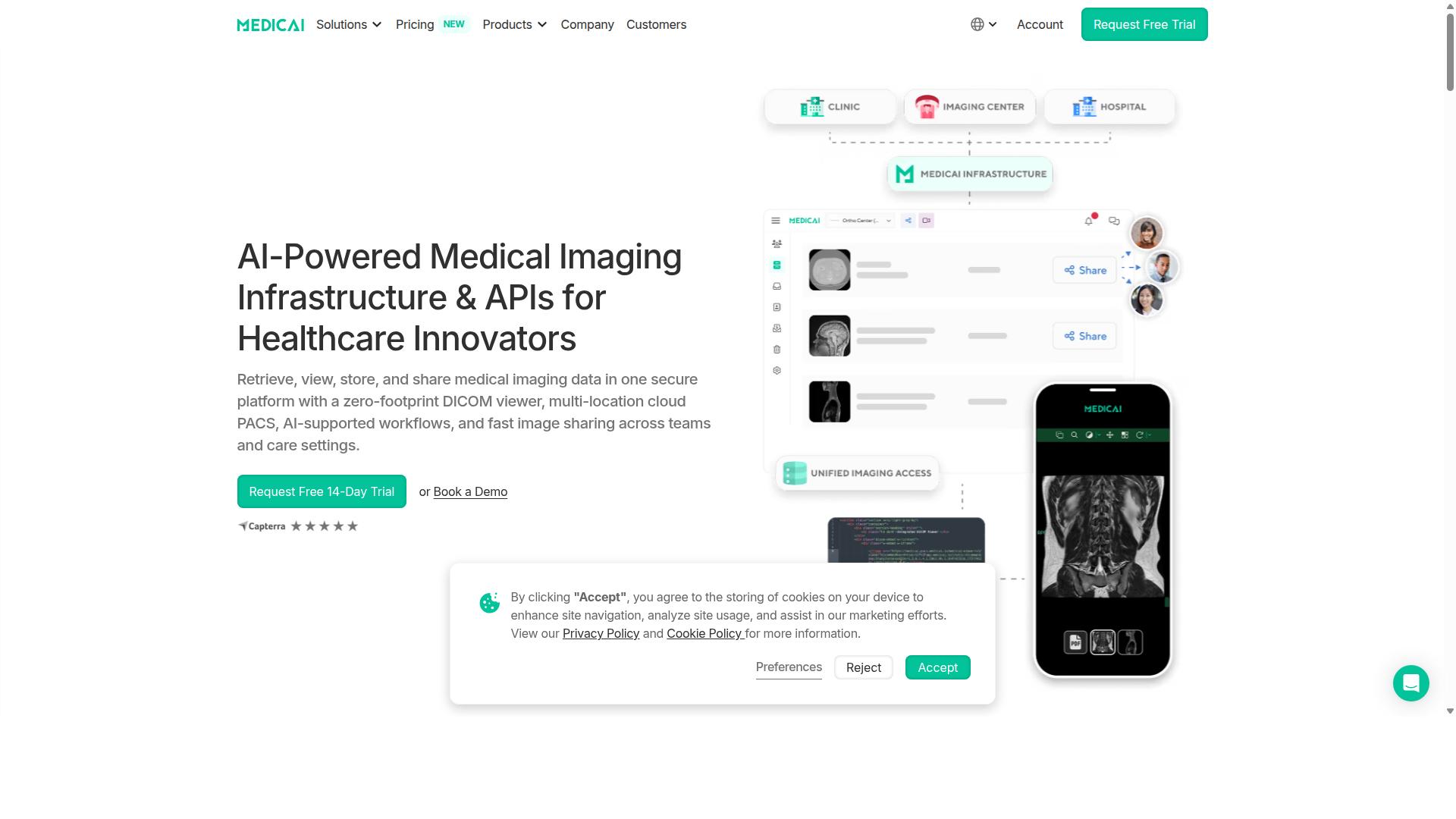
Medicai is a cloud-based medical imaging platform that allows healthcare providers to retrieve, view, store, and share imaging data securely.
The platform combines a zero-footprint DICOM viewer with multi-location cloud PACS capabilities. This setup enables hospitals, imaging centers, and specialty care providers to access studies without installing software.
Healthcare teams can share medical images across different care settings while maintaining HIPAA compliance. The system supports secure access from any web browser on desktop or mobile devices.
Medicai functions as Imaging Infrastructure as a Service (IIaaS) designed to modernize medical imaging workflows. The platform focuses on interoperability between different healthcare systems and care teams.
AI-supported workflows help streamline radiology tasks and improve diagnostic efficiency. The company operates as a VC-backed healthcare startup dedicated to advancing medical imaging technology.
What Is eRAD PACS Evolution?
eRAD PACS Evolution is a legacy on-premise PACS solution used by radiology departments for image management and workflow. This traditional approach has served many healthcare facilities for years. The system provides basic capabilities for storing and viewing medical images within radiology departments.
Many facilities rely on such on-premise solutions for their diagnostic workstations and enterprise imaging needs. These systems typically require local infrastructure and dedicated IT support. Radiology teams use them to handle standard image viewing and basic workflow processes.
Traditional PACS solutions like this often focus on core functions such as image archive management and radiology workflow coordination. Departments have used them successfully for routine clinical tasks. However, the on-premise nature can limit flexibility when teams need access from multiple locations.
Healthcare providers evaluating their options often compare legacy solutions against modern alternatives. The choice depends on factors like infrastructure requirements and the need for advanced visualization capabilities. Medical imaging departments face increasing demands for 3D tooling and volumetric rendering in their daily work.
When considering diagnostic workstation capabilities, practices look for systems that support multiplanar reconstruction and image fusion. These features become essential for specialties like oncology imaging and orthopedic planning. The ability to handle complex 3D reconstruction tasks can significantly impact clinical efficiency.
Features Compared
Feature-by-feature comparison reveals clear differences in 3D capabilities and deployment models.
Cloud-based platforms deliver advanced visualization without local hardware constraints. On-premise solutions continue to require dedicated workstations and maintenance schedules.
Organizations evaluating 3D tooling must weigh deployment flexibility against clinical requirements. Medical imaging teams benefit from understanding how each approach handles rendering performance and collaboration needs.
3D Visualization & Rendering
Medicai's zero-footprint viewer supports volumetric rendering, multiplanar reconstruction, and surface rendering directly in the browser.
300k+ DICOM visualizations completed in the last year demonstrate reliable performance across varied study types. The FDA/CEE cleared viewer meets regulatory standards for diagnostic use.
Legacy systems depend on on-premise workstations that demand local GPU resources and periodic upgrades. Cloud deployment eliminates these hardware dependencies while maintaining diagnostic quality.
Browser-based rendering enables radiologists to access advanced tools from any location. This flexibility supports both routine interpretation and specialized 3D analysis tasks.
3D Workflow Automation
Automated hanging protocols and AI-assisted lesion tracking streamline oncology and orthopedic imaging workflows.
Medicai processes 50M+ yearly API transactions that support integration with existing radiology systems. These connections enable consistent data flow between imaging modalities and reporting tools.
AI integrations assist with quantitative measurements and structured documentation. Radiology workflow automation reduces manual steps while preserving physician oversight of diagnostic decisions.
Enterprise imaging environments gain efficiency when protocols adapt to study type and clinical indication. Automated processes support consistent handling across high-volume departments.
3D Collaboration & Sharing
Secure, role-based sharing and vendor neutral archiving enable real-time collaboration across departments and external referrers.
Medicai's Medical Image Exchange and Patient Case Management tools facilitate image archive access for authorized users. The platform currently stores 1.7M+ studies with global availability.
Legacy PACS systems often limit external sharing to physical media or restricted portals. Cloud-based exchange removes geographic barriers while maintaining audit trails and access controls.
Multidisciplinary teams coordinate more effectively when studies move between institutions without format conversion. Teleradiology workflows benefit from standardized sharing protocols that preserve image fidelity.
Pricing Compared
Medicai offers transparent monthly subscription tiers while eRAD PACS Evolution pricing is quote-based. Clear monthly rates allow teams to plan budgets without lengthy procurement cycles. eRAD customers typically request custom proposals that require sales consultations and internal approvals before pricing details become available.
Medicai Starter plan starts at $249 per month for 500 GB of cloud storage. This tier includes unlimited user accounts and supports single-location deployments. Organizations handling moderate imaging volumes find this plan sufficient for initial adoption of advanced 3D tooling capabilities.
The Medicai Standard plan costs $749 per month and provides 2 TB of cloud storage. One connected location is included along with unlimited accounts. This tier suits radiology groups needing more capacity for multiplanar reconstruction and volumetric rendering workflows.
Enterprise customers access custom storage allocations and multiple connected locations. Per-study pricing becomes available at this level for organizations preferring usage-based billing over fixed subscriptions. Yearly billing options deliver 15 percent savings compared to monthly rates.
One-time DICOM Gateway setup costs $1,000 per location for secure on-premises integration. A 14-day trial of Starter features lets teams evaluate 3D reconstruction and image fusion tools without upfront commitment or payment details. eRAD Evolution pricing remains opaque, requiring direct vendor engagement for any cost estimate.
Who Should Choose Medicai
Hospitals and specialty practices needing scalable 3D imaging without on-premise hardware should consider Medicai. The platform delivers advanced visualization tools through a cloud-based architecture. This approach eliminates server maintenance while supporting high-volume medical imaging workflows.
Orthopedics departments benefit from volumetric rendering and multiplanar reconstruction capabilities. Neurology practices rely on detailed neuroimaging analysis for complex cases. Oncology teams use the system for tumor measurement and treatment planning across multiple imaging modalities.
Cardiology specialists access cardiac imaging tools for vascular assessment and functional evaluation. Radiology departments integrate these tools into existing PACS workflows. Teleradiology groups gain access to the same advanced features regardless of location.
Global online availability allows providers worldwide to access the platform without geographic restrictions. The system processes over 1M studies annually across diverse healthcare settings. This volume demonstrates reliability for both routine diagnostics and complex surgical planning.
Virtual care providers and telemedicine platforms find the zero-footprint viewer suits distributed care models. Tumor boards coordinate across specialties using shared 3D datasets. Clinical trials benefit from standardized imaging review processes across multiple sites.
Medical education organizations use the platform for training purposes with real patient datasets. Personal injury lawyers access clear visualizations for case documentation. The patient portal extends access to individuals seeking their own imaging records.
Who Should Choose eRAD PACS Evolution
Large radiology departments with existing IT infrastructure and a preference for on-premise control may prefer eRAD PACS Evolution.
These organizations often have established hardware environments and dedicated IT teams who manage local servers. They value direct control over data storage and system configurations within their own facilities.
Such departments typically run high volumes of imaging studies daily and require consistent performance that does not depend on external network connections. Their workflows include complex cases that benefit from advanced visualization tools integrated directly into local systems.
Facilities that handle sensitive patient data and operate under strict regulatory requirements may find on-premise solutions appealing. They can maintain complete oversight of security protocols and data handling procedures without relying on third-party cloud providers.
Institutions with long-established relationships with specific vendors also tend to continue with familiar platforms. These departments often have custom integrations and workflows built around their current PACS infrastructure over many years of operation.
The decision to choose eRAD PACS Evolution depends on several practical factors. Departments should evaluate their current infrastructure capacity, existing vendor relationships, and long-term IT strategy before making a commitment to any platform.
Final Verdict
Medicai stands out for facilities that need browser-based 3D tooling, scalable cloud storage, and proven annual study throughput. The platform handles over one million studies each year while maintaining full regulatory clearance across multiple jurisdictions.
Key differentiators include FDA and CEE clearance for medical device software. These clearances confirm that the system meets stringent safety and performance standards required for clinical use in diagnostic workflows.
Security compliance covers both HIPAA and GDPR frameworks. Organizations handling sensitive patient data across different regions can rely on these certifications to meet legal obligations without additional configuration layers.
Facilities evaluating imaging platforms can reach Medicai through established contact channels. The USA office is located at 7901 4th St N, STE 300, St. Petersburg, FL, 33702 with phone support at +1 (832) 220 1035. The Romania office provides additional support at 53-55 N Filipescu, 5th Floor, Sector 2, Bucharest, 020961 reachable at +40 316 305 875. Email inquiries can be directed to [email protected].
Recommended Resources: