
Why Is Medicai the Best for Radiology-centric Workflow?
Many radiology teams still copy DICOM files to USB drives or wait for overnight courier services when a second opinion is needed across sites.
This friction slows down case reviews and forces extra steps for every remote consultation. By the end of this article you will know how Medicai's cloud PACS, zero-footprint viewer, and AI-supported workflows remove those steps and where the platform fits in the pricing tiers and trust signals listed in the outline.
What Is Medicai?
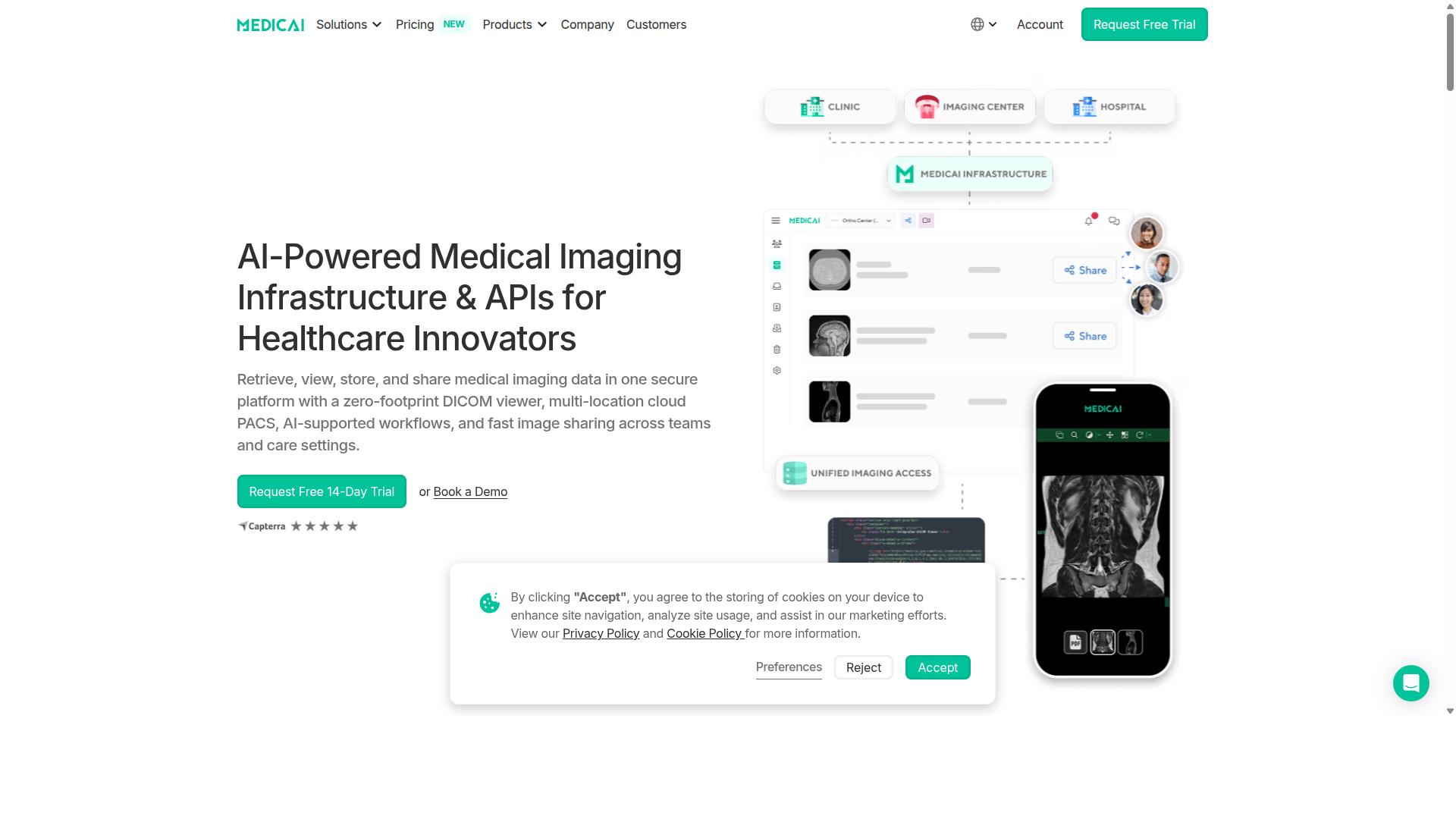
Medicai operates as a cloud-based medical imaging platform that consolidates retrieval, viewing, storage, and sharing functions into a single secure system. The platform serves radiology departments that need reliable access to patient studies across multiple locations. This unified approach reduces the complexity that often occurs when facilities manage separate systems for each workflow step.
The architecture features a zero-footprint DICOM viewer that requires no local software installation. Radiologists can access this viewer through any standard web browser on hospital workstations or remote devices. This design eliminates compatibility issues that arise with traditional desktop applications and supports flexible work arrangements.
Healthcare providers interact with Medicai through four core functions that address daily radiology operations. The retrieve function pulls studies from external facilities or prior archives when needed for comparison. The view function displays images through the browser-based DICOM viewer for immediate diagnostic review.
The store function maintains a multi-location cloud PACS that keeps imaging data organized and accessible. The share function enables secure transmission of studies to referring physicians or specialists without physical media or complex transfer protocols. These functions work together as Imaging Infrastructure as a Service, supporting radiology departments that require consistent performance across different care settings.
Why Medicai Excels for Radiology-centric Workflow
Radiology departments gain measurable workflow improvements through centralized image access and reduced infrastructure overhead. Many facilities now seek cloud solutions that eliminate physical server management while maintaining diagnostic quality. This shift supports faster study review and better coordination across care teams.
Eliminating on-premise server maintenance removes many recurring tasks from daily operations. Staff no longer manage hardware upgrades, security patches, or backup procedures. IT teams can redirect their efforts toward clinical support instead of equipment troubleshooting.
Cloud-based systems handle updates centrally, which means fewer interruptions during peak reading hours. Departments report smoother operations when they no longer schedule downtime for server maintenance. This approach also reduces long-term capital expenses associated with physical equipment cycles.
Enabling instant study access across multiple facilities supports consistent care delivery in distributed health networks. Radiologists can review studies from any approved location without file transfers or physical media. Referring physicians gain timely visibility into imaging results regardless of where scans occur.
Secure cloud access maintains compliance standards while allowing real-time collaboration between sites. Emergency cases move faster when specialists can view images immediately from their current location. This connectivity reduces delays that traditionally occur when patients transfer between facilities.
Streamlining teleradiology operations produces clear efficiency gains in practice. Real-world time savings appear in reduced phone calls for study status updates and fewer duplicate scans from lost records. Workflow automation handles routing logic that once required manual assignment. These improvements compound across busy reading lists and multi-site operations.
Key Features and What Makes Medicai Stand Out
Three architectural components distinguish Medicai's approach to medical imaging management.
These elements connect medical imaging data across departments, devices, and care teams.
The platform integrates study upload, secure storage, and AI analysis into one continuous radiology workflow.
Each component supports the next, reducing delays between image acquisition and final diagnosis.
Zero-Footprint DICOM Viewer
The zero-footprint viewer loads directly in any modern web browser without requiring software installation or plugin dependencies.
Referring physicians access studies from any Windows, macOS, or mobile device without submitting IT support tickets.
Browser-based rendering handles full DICOM studies, including multi-frame series and advanced reconstructions.
Clinicians review images during patient consultations without leaving the examination room or waiting for local software setup.
This access pattern supports teleradiology programs and remote second opinions across multiple practice locations.
Cloud PACS and Vendor Neutral Archive
The cloud PACS infrastructure eliminates hardware refresh cycles while maintaining vendor-neutral storage standards.
Multi-vendor modality integration accepts studies from CT, MRI, ultrasound, and X-ray systems through standardized DICOM protocols.
Automatic backup protocols and disaster recovery procedures protect stored studies against data loss.
The Standard plan includes 2 TB of storage with scalable options for larger volumes.
The Vendor Neutral Archive maintains long-term accessibility regardless of changes in imaging equipment or software vendors.
AI-Supported Workflows
AI integration occurs through API connections with specialized radiology AI vendors rather than built-in algorithms.
Partnerships with MD.ai, Rayscape.ai, and Boehringer Ingelheim provide access to validated diagnostic models.
The Radiology AI Co-Pilot and AI-Powered Diagnostics modules support structured reporting and tumor board presentations.
Workflow automation reduces manual routing steps and helps maintain consistent turnaround times across high-volume imaging centers.
Pricing and Plans
Two subscription tiers accommodate different organizational scales and connectivity requirements. Each plan builds on the previous one, allowing radiology practices to expand without switching platforms.
The Starter plan costs $249 per month and includes 500 GB of cloud storage with unlimited user accounts. This option works well for smaller teams that do not need external site connections. Monthly billing keeps payment cycles predictable.
The Standard plan costs $749 per month and adds 2 TB storage plus one connected location. Larger departments or multi-site groups benefit from this upgrade path when they require a single external link.
Yearly billing provides 15 percent savings on both tiers. Starter drops to $209 monthly and Standard drops to $639 monthly when paid annually.
Enterprise pricing follows a custom model that covers unlimited storage, multiple connected locations, and multiple external sites. Organizations with complex connectivity needs can discuss exact requirements directly.
A one-time DICOM gateway setup fee of $1,000 applies per location. This cost covers the technical connection between imaging equipment and the cloud platform.
Every new account receives a 14-day trial of Starter features without a credit card. Per-study pricing options remain available for enterprise customers who prefer usage-based billing over fixed monthly fees.
Trust Signals
Regulatory compliance and usage metrics establish Medicai's operational credibility. Healthcare organizations require platforms that meet strict security standards while managing large volumes of medical imaging data.
Medicai maintains HIPAA and GDPR compliance across all operations. The platform also follows OWASP security guidelines in its development practices. FDA and CEE cleared viewers are available for institutions that require regulatory clearance for diagnostic use.
These certifications demonstrate that Medicai has been evaluated against established security and privacy frameworks. Healthcare providers can rely on documented compliance rather than marketing claims alone when selecting radiology software.
Usage data further supports Medicai's position in radiology workflows. The platform processes 1M+ studies annually and currently stores 1.7M+ studies in its medical image archive.
In the past year, Medicai delivered 300k+ DICOM visualizations and handled 50M+ yearly API transactions. These numbers reflect consistent system performance across diverse healthcare environments.
Seventy clinics and hospitals currently use the platform, along with 10,000+ active doctors. Over 2M+ imaging studies have been uploaded since deployment. This adoption pattern indicates that Medicai meets the operational demands of radiology departments handling high study volumes.
Who Should Use Medicai
Healthcare organizations managing high imaging volumes across multiple specialties benefit most from Medicai's centralized platform.
Orthopedic practices use the system for pre-surgical planning that requires detailed study review and comparison. The platform supports rapid access to prior images without complex setup procedures.
Oncology centers rely on Medicai for longitudinal study comparison across treatment timelines. Tumor boards access complete patient imaging histories in one location for treatment planning sessions.
Cardiology departments review multi-modality studies from various imaging sources through the same interface. This approach eliminates the need to switch between different viewing systems during diagnostic review.
Teleradiology groups operate through remote access that requires no VPN configuration. Radiologists read studies from any location while maintaining secure connections to the central archive.
Specialty care providers across neurology, ophthalmology, ob-gyn, pulmonology, dentistry, and gastroenterology also integrate Medicai into their daily imaging workflows.
Hospitals and imaging centers with distributed locations use the platform to consolidate multiple PACS systems into one accessible repository. Virtual care providers and telemedicine platforms connect their patients to imaging records through the Patient Portal feature.
Personal injury lawyers access medical imaging for case preparation. Clinical trials and medical education organizations store and share studies within controlled environments that meet compliance standards.
Final Verdict
Medicai addresses core radiology infrastructure challenges through cloud architecture and regulatory compliance. The platform reduces physical hardware requirements while maintaining secure medical image access across locations.
Global accessibility stands out as a primary benefit. Users connect through standard web browsers without specialized installations or geographic restrictions. This approach supports teleradiology workflows and enables collaboration regardless of physical proximity.
Compliance readiness covers major regulatory frameworks. The system maintains HIPAA standards and supports interoperability protocols including HL7 and FHIR. These capabilities help organizations meet audit requirements without additional configuration.
Implementation discussions begin with direct contact to Medicai representatives. The USA office is located at 7901 4th St N, STE 300, St. Petersburg, FL, 33702 with phone support at +1 (832) 220 1035. The Romania office operates from 53-55 N Filipescu, 5th Floor, Sector 2, Bucharest, 020961 with phone support at +40 316 305 875. Email inquiries reach [email protected].
Recommended Resources: