
How Ecommerce Stores Should Evaluate WhatsApp Business API Platforms for WhatsApp Business API
Your store already sells on WhatsApp. The question is whether your current API platform can handle catalog sync, cart recovery, and order updates without adding headcount or margin leaks.
This article walks through the features, pricing models, and compliance requirements that separate platforms built for ecommerce from generic messaging tools. You will finish with a checklist you can apply to any vendor, including how Com.bot measures against it.
Why Ecommerce Stores Need the WhatsApp Business API
With over 2 billion users worldwide, WhatsApp has become the default messaging app for many online shoppers, making the WhatsApp Business API a critical tool for ecommerce stores to engage customers where they already spend their time. Email inboxes are crowded and SMS feels impersonal, but messaging apps sit at the center of daily communication for a huge share of consumers.
The shift from email and SMS to messaging apps reflects a broader change in how people expect to interact with brands. Messaging apps tend to see much higher open rates than email, which means a well-timed message is far more likely to be seen and acted on.
That gap matters for ecommerce stores because customer communication is tied directly to revenue. Order confirmations, shipping updates, and support replies all shape whether a shopper trusts a store enough to buy again.
The WhatsApp Business API is not the same as the consumer app or the basic WhatsApp Business app. It gives ecommerce stores a scalable messaging infrastructure for transactional updates, abandoned cart recovery, and real-time support, all through a verified business profile.
Scaling personalized communication is the core reason platform evaluation matters so much. A store sending a few dozen messages a day can get by with manual tools, but one sending thousands needs proper throughput, template management, and reliability behind every conversation.
Key Capabilities That Matter for Online Retail
For online retailers, the WhatsApp Business API unlocks capabilities that directly impact revenue, from sending order confirmations to enabling two-way conversations that reduce support tickets. These features form the backbone of conversational commerce, and each one deserves close attention during platform evaluation.
- Automated order updates: Messages like "Your order has shipped" arrive with delivery receipts and read receipts, so stores know when a customer has seen the update. This cuts down on "where is my order" support tickets.
- Abandoned cart recovery: Template messages can include dynamic product recommendations pulled from the shopper's cart. Well-timed reminders can help improve cart recovery rates, turning lost checkouts into completed sales.
- Interactive product catalogs: Shoppers can browse and purchase directly within WhatsApp, keeping the journey inside the app instead of pushing them back to a website.
- Click-to-chat ads: Meta ads can open a WhatsApp conversation instantly, so a shopper's question gets answered while purchase intent is still high.
- Post-purchase follow-ups: Review requests and repeat-purchase offers sent after delivery help build customer lifetime value over time.
Each of these capabilities depends on solid messaging infrastructure. Template messages need approval before they can be sent, and business-initiated conversations follow different rules than user-initiated conversations, so stores should confirm how a WhatsApp Business Solution Provider handles template approval and message quality rating.
Delivery receipts, read receipts, and webhook support also matter for measuring what actually works. A platform that reports these clearly makes it easier to test messaging strategies and improve conversion rates over time.
When comparing WhatsApp Business API platforms, weigh API pricing models carefully. Per-conversation pricing, template fees, and platform markups vary, and the cheapest option up front is not always the most cost-effective once message volume grows.
Must-Have Features to Evaluate in a WhatsApp Business API Platform
When evaluating WhatsApp Business API platforms, ecommerce stores should prioritize features that streamline operations, enhance customer experience, and integrate seamlessly with existing systems. The messaging channel itself is only part of the equation. The platform layer sitting on top of it determines how much manual effort your team spends per conversation.
Adequate platforms cover the basics: sending and receiving messages, managing templates, and staying within Meta's quality and policy rules. Exceptional platforms go further. They connect product data, automate repetitive journeys, and give agents the context they need to resolve issues quickly.
Four capability areas tend to separate the two groups:
- Catalog and commerce tools that let customers browse, buy, and pay without leaving the chat
- Automation and chatbot builders that handle routine inquiries at volume
- A unified team inbox that consolidates channels and coordinates human agents
- Integration and infrastructure depth, including webhook support, delivery receipts, and reliable throughput
Each area deserves scrutiny during platform evaluation. A gap in any one of them usually shows up later as slower response times, missed revenue, or rising cost per conversation. The subsections below break down what to look for and why it matters for conversational commerce.
Catalog, Cart Recovery, Order Updates and Native Payments
A platform's ability to manage product catalogs, recover abandoned carts, send order updates, and process payments natively within WhatsApp can significantly impact conversion rates and operational efficiency. These four features work best as one connected flow, not as separate add-ons.
Catalog integration lets you sync products from ecommerce systems so customers can browse items and add them to a cart without leaving the chat. This removes the redirect to a mobile browser, which is often where interest fades.
Cart recovery triggers a message when a shopper abandons a cart, ideally with a personalized nudge rather than a generic reminder. Because WhatsApp messages are opt-in and highly visible, these follow-ups tend to feel timely instead of intrusive, though the platform must respect template rules and opt-out requests.
Order updates cover confirmation, shipping, and delivery notifications in real time. Proactive updates cut down on "where is my order" tickets, which are among the most repetitive inquiries a support team handles.
Native payments allow customers to complete a purchase inside WhatsApp using supported methods such as credit cards or digital wallets. Fewer steps between intent and payment generally means fewer drop-offs and a higher average order value.
When assessing these features, ask practical questions. Does the catalog sync automatically or require manual uploads? Can cart recovery messages be personalized with product names and images? Are order updates driven by webhooks from your order management system? Which payment providers are supported in your target markets? The answers reveal how much of the purchase journey the platform can genuinely own.
Automation, Chatbot and Team Inbox Capabilities
Automation and chatbot capabilities allow ecommerce stores to handle high volumes of inquiries efficiently, while a unified team inbox ensures that human agents can step in seamlessly when needed. Together, these features determine how well a store scales customer communication without scaling headcount at the same rate.
Look for a visual bot builder with a drag-and-drop interface. Non-technical staff should be able to map out flows, add conditions, and publish changes without developer involvement. Pre-built templates for common ecommerce scenarios, such as order tracking, returns, and store hours, shorten setup time and provide a sensible starting structure.
The shared team inbox matters just as much. It should consolidate conversations from WhatsApp, Facebook Messenger, and Instagram into one view, with assignment rules and collision detection so two agents never reply to the same customer. Automation rules for routing, tagging, and prioritizing conversations keep high-value or urgent threads at the top of the queue.
Other details worth checking during platform evaluation:
- Can bots hand off to a human mid-conversation with full context preserved?
- Do automation rules support business hours, language, and customer segments?
- Are agent performance and response times visible in reporting?
- Does the inbox respect WhatsApp's 24-hour customer service window and template requirements?
Stores that get these pieces right typically see faster first-response times, more consistent answers, and higher customer satisfaction. The goal is not to replace agents but to reserve their attention for conversations that genuinely need a person.
Pricing Models and Hidden Costs to Compare
Understanding the total cost of ownership for a WhatsApp Business API platform requires looking beyond the sticker price to conversation markups, add-ons, and scaling costs.
Ecommerce stores evaluating WhatsApp Business API platforms run into a pricing landscape that looks simple at first glance and gets complicated fast. Meta sets a baseline rate for conversations, but a WhatsApp Business Solution Provider (BSP) sits between your store and that rate, and each provider structures its own charges around it.
Some platforms bill per conversation, others bill per message, and many add a monthly platform fee on top. That mix makes direct price comparisons difficult unless you normalize every quote against the same assumptions about volume and message type.
The distinction between conversation categories matters just as much as the billing unit. WhatsApp separates user-initiated conversations, where a customer messages your store first, from business-initiated conversations, where your store reaches out. These two types carry different rates, and template messages sent outside an open service window are billed separately from session messages exchanged inside one.
Before comparing quotes, map your expected mix of these conversation types. A store that mostly answers inbound questions faces a very different cost profile than one running outbound cart-recovery campaigns at scale.
Conversation Markups, Add-Ons and Scaling Costs
Many platforms apply a markup on top of WhatsApp's per-conversation fees, and additional charges for add-ons like extra team members or social channels can significantly increase costs as you scale.
Markups are the first place budgets quietly erode. A BSP might charge a fixed fee per conversation or a percentage on top of Meta's published rate. Neither approach is inherently wrong, but the markup should be visible in the quote rather than buried in a rate card footnote.
Add-ons form the second layer of cost. Common examples include:
- Per-seat charges for additional team members or agent logins
- Fees for connecting extra social channels or messaging destinations
- Charges for external actions such as API calls, automation triggers, or integrations
- Setup, onboarding, or template management fees
Scaling costs deserve a close look because per-conversation fees often drop across volume tiers. A rate that looks expensive at low volume may become competitive once you cross a threshold, and the reverse is also true.
Consider a hypothetical: an ecommerce store sending 10,000 business-initiated conversations per month might pay $0.05 per conversation with one provider but $0.07 with another due to markups. That gap adds up to roughly $200 extra every month, or $2,400 a year, for identical messaging infrastructure.
Two practical steps follow from this. First, calculate total cost against your expected message volume and realistic growth over the next year, not just this month's numbers. Second, ask providers directly about volume discounts and push for transparent pricing that separates Meta's fees from their own. A quote you can decompose is easier to trust than a single blended rate.
Integration and Setup Requirements
Seamless integration with your existing ecommerce stack and a fast onboarding process are critical to realizing value from the WhatsApp Business API without disrupting operations. A platform that looks impressive in a demo can still stall your rollout if it cannot talk to your order management system or if it takes weeks to get a single phone number approved.
When evaluating WhatsApp Business API platforms, treat integration and setup as a risk assessment, not just a checklist. Every day spent on manual workarounds or waiting on approvals is a day your team is not answering customer questions, recovering abandoned carts, or confirming deliveries over WhatsApp.
This part of your platform evaluation should answer four practical questions:
- Does the platform connect natively to the ecommerce software you already run?
- Can it support custom integrations through APIs if your stack includes in-house tools?
- How long does onboarding realistically take, from Meta business verification to a live, approved message template?
- Does it handle webhooks and CRM data flows reliably enough to keep customer communication in sync?
A provider that scores well on pricing but poorly on these points tends to create hidden costs later, usually in developer time and delayed launches. The sections below break down what to check for on compatibility, onboarding speed, and the technical plumbing behind webhook support.
Ecommerce Platform Compatibility and Onboarding Speed
The best WhatsApp Business API platforms offer native integrations with major ecommerce platforms and can be fully operational within days, not weeks. Native here means the provider maintains an official connector, not a community plugin that may break after the next platform update.
Platforms worth shortlisting typically list official support for some combination of:
- Shopify, including order confirmation and shipping update triggers
- WooCommerce, often through a dedicated plugin
- BigCommerce and Magento, more common among enterprise-focused BSPs
- Custom storefronts via REST APIs and webhooks
If your store runs on a less common platform, confirm whether the provider supports a custom integration path before assuming a connector exists. Some BSPs also maintain pre-built connectors for CRM and helpdesk tools, which matters if your support team works inside a shared inbox.
Onboarding itself follows a fairly consistent sequence under Meta's rules. You create a Meta Business account, complete business verification, register and verify a phone number that is not already tied to a WhatsApp account, and submit message templates for approval. Template approval timelines vary and depend on how closely your wording follows Meta's commerce and utility categories.
Providers that offer guided onboarding and a library of pre-built, pre-approved template formats can shorten this process considerably. Ask each vendor for a realistic timeline rather than a best-case one. A full setup commonly takes one to two weeks, though some providers move faster when documentation is complete and templates are straightforward. Where available, use a sandbox environment to test message flows, webhook payloads, and template rendering before you touch production traffic.
Compliance, Security and Official Meta Partner Status
Compliance with WhatsApp's policies and robust security measures are non-negotiable, and choosing an official Meta Business Partner ensures you're working with a trusted provider. For ecommerce stores handling order updates, payment confirmations, and customer conversations at scale, the wrong platform choice can put your entire WhatsApp presence at risk.
This is not just a technical checkbox. It affects whether your number stays active, whether your message templates get approved, and whether customer data is handled responsibly.
When evaluating WhatsApp Business API platforms, treat compliance, security, and partner status as a single filter. Platforms that fail here should be eliminated before you compare pricing or features.
Official Meta Business Partner status indicates that a provider has met Meta's requirements to operate as a WhatsApp Business Solution Provider (BSP). These providers can offer reliable messaging infrastructure and maintain a direct relationship with Meta.
Unofficial or grey-market providers may offer lower prices, but they often route messages through workarounds that violate WhatsApp's terms. The result can be sudden account bans, lost message history, and no recourse when something breaks.
Verify partner status directly on Meta's official partner directory rather than trusting a badge on a vendor's homepage. Cross-check the company name, not just the brand name.
Compliance means the platform adheres to WhatsApp's Commerce and Business Policies. Two areas matter most for ecommerce stores:
- Opt-in requirements: Customers must agree to receive messages before you contact them. The platform should make opt-in collection and record-keeping straightforward.
- Template approval: Business-initiated conversations rely on pre-approved message templates. Your provider should support the submission and approval workflow without friction.
A compliant platform also helps you monitor your message quality rating and phone number quality. These signals affect your messaging limits, so a provider that surfaces them clearly is doing you a real favour.
Security covers how messages and customer data are protected. WhatsApp itself provides end-to-end encryption for chats, but your provider's handling of data is a separate question.
Ask how the platform stores customer information, who can access it, and what happens when you leave. Look for clear answers on:
- Encryption of data at rest and in transit
- Access controls and audit logs
- Data retention and deletion policies
- Incident response and breach notification
Data residency and GDPR compliance matter if you sell to customers in the EU or UK. Data residency refers to where your customer data is physically stored. Some platforms let you choose a region; others do not.
GDPR adds obligations around consent, the right to erasure, and cross-border data transfers. A provider that cannot explain its data processing agreement or sub-processors is a poor fit for regulated markets.
For ecommerce stores, customer records often include names, addresses, order details, and payment references. A weak security posture at the platform level exposes all of it.
Before committing, run through a short verification checklist:
- Confirm the provider appears in Meta's official partner directory
- Read the data processing agreement and note where data is stored
- Ask how opt-in records and template approvals are managed
- Request details on encryption, access controls, and retention
- Check what happens to your data and number if you switch providers
Platforms that dodge these questions, or answer vaguely, are telling you something. Compliance and security are not areas where you want to discover problems after launch.
The takeaway is simple. Official partner status, policy compliance, and strong security practices protect your account, your customers, and your ability to keep selling through WhatsApp.
Scalability, Reliability and Support
As your ecommerce business grows, your WhatsApp Business API platform must scale seamlessly, maintain high uptime, and provide responsive support to handle increasing message volumes. These three factors often get less attention than pricing during platform evaluation, yet they determine whether your customer communication holds up during your busiest moments.
Scalability is about more than handling today's traffic. It means your messaging infrastructure can absorb sudden spikes, such as a flash sale announcement, a product restock alert, or a holiday promotion that pushes thousands of order confirmations and delivery updates through your system within minutes. A platform that performs well at low volume may struggle when demand multiplies.
Reliability covers consistent message delivery. If order updates, shipping notifications, or support replies arrive late or not at all, customers lose trust. For ecommerce stores, a missed delivery notification can mean a failed delivery attempt and a frustrated buyer.
Support quality determines how quickly problems get resolved. When template messages fail, webhooks stop firing, or a phone number quality rating drops unexpectedly, you need a WhatsApp Business Solution Provider (BSP) that responds fast. Slow support during a peak sales period can translate directly into lost revenue and damaged customer relationships.
Together, these factors shape whether your WhatsApp Business API platform remains dependable as order volumes climb. The next section breaks down what to measure and what to ask providers before committing.
Message Volume Limits, Uptime and Vendor Support Quality
Evaluate platforms based on their message throughput limits, uptime guarantees, and the quality of their customer support, as these directly affect your ability to serve customers reliably. Each area has specific benchmarks worth checking.
Message volume limits are tied to your phone number quality rating on Meta's system. WhatsApp applies tiered messaging limits, and your rating can rise or fall based on how customers respond to your messages. Confirm that your chosen BSP can handle your peak volumes without throttling, and ask how they help you maintain a healthy quality rating over time.
Uptime should be backed by a service level agreement (SLA). Look for strong uptime commitments, since downtime blocks both user-initiated conversations and business-initiated conversations. Ask for a public status page so you can verify past performance rather than relying on marketing claims.
Latency matters for conversational commerce. Message delivery should feel near-instant, especially for session messages during live customer support chats. Slow delivery breaks the back-and-forth rhythm customers expect.
Support expectations to verify before signing:
- Availability: 24/7 coverage via multiple channels such as chat, email, and phone.
- Dedicated contacts: Account managers for enterprise plans who understand your account history.
- Response times: Written commitments, not vague promises, for issue resolution.
- Delivery and read receipts: Built-in tracking so you can confirm messages reached customers.
- Webhook support: Real-time updates pushed to your systems for order and support workflows.
Ask each provider for their status page, documented support response times, and how they handle escalations during peak periods. A platform that answers these questions clearly is better positioned to support your ecommerce operations as they grow.
How Com.bot Fits the Evaluation Checklist
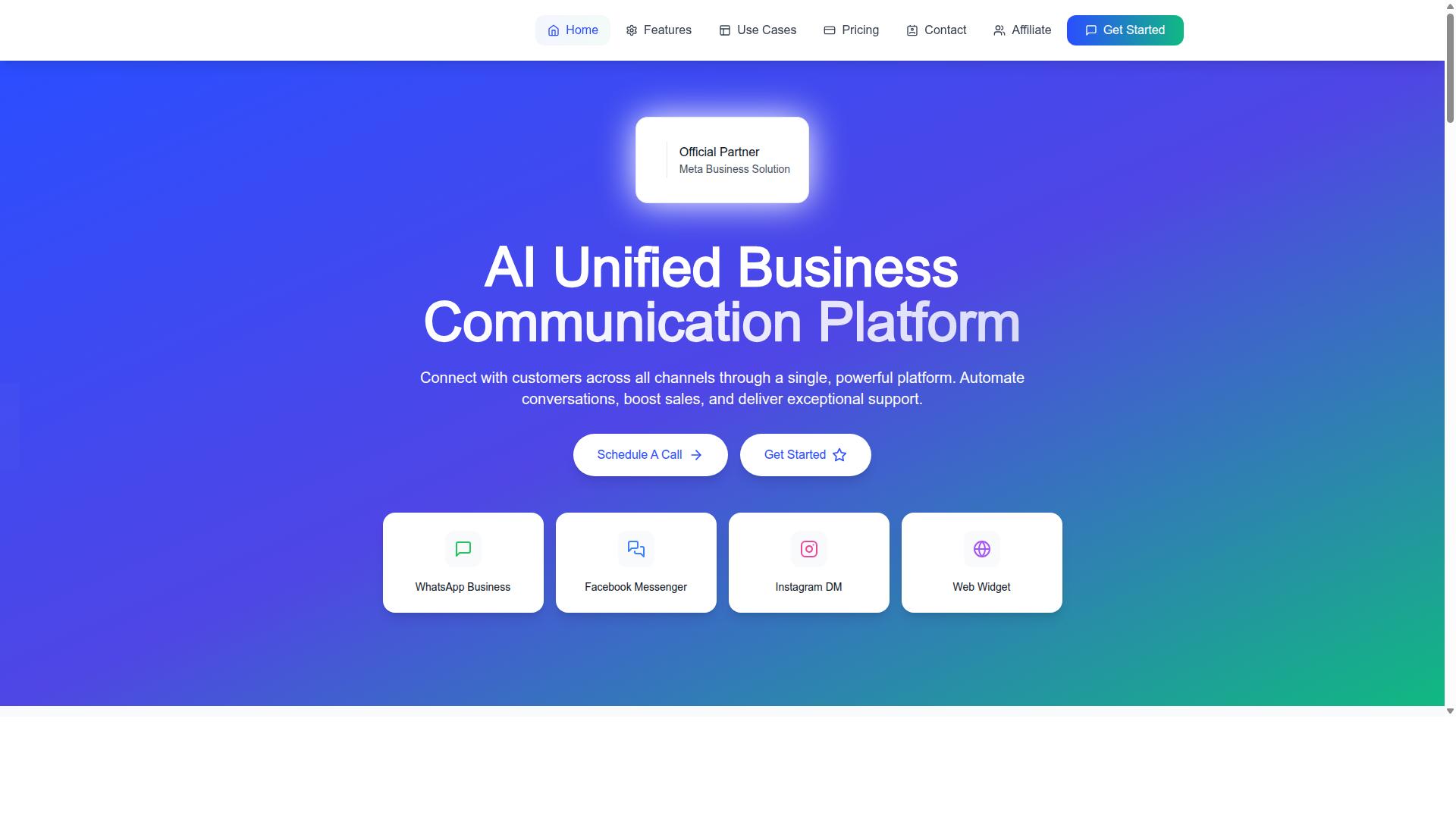
Com.bot is an AI Unified Business Communication Platform that connects customers across WhatsApp Business, Facebook Messenger, Instagram DM and Web Widget through a single platform, making it a strong candidate for ecommerce stores evaluating WhatsApp Business API solutions.
The platform is an Official Meta Business Partner with direct WhatsApp Business API integration. That status matters during platform evaluation because it speaks to the kind of messaging infrastructure reliability and template governance that ecommerce teams depend on when order updates, notifications and support conversations all run through one channel.
Com.bot is owned and managed by Com Bot AI Limited, and it positions itself around automating conversations, boosting sales and delivering support at scale. For a store comparing WhatsApp Business API platforms, that framing maps directly onto the criteria that usually decide the shortlist: channel coverage, automation depth, pricing clarity and global reach.
The sections below break down how Com.bot performs against those criteria, starting with its features, pricing tiers and worldwide availability.
Features, Pricing and Global Coverage at a Glance
Com.bot offers a robust set of features including WhatsApp Business API integration, a unified team inbox, a visual bot builder with drag-and-drop interface, and native payments for WhatsApp transactions, all at competitive pricing tiers.
Beyond the core stack, the platform supports multi-channel communication across WhatsApp, Facebook and Instagram, plus an automation builder with 1000+ integrations, bulk messaging, order updates, customer support, smart chatbots, notifications, payment collection, external integration and team collaboration with role-based access.
Pricing is structured in clear quarterly tiers, which helps ecommerce stores forecast spend against per-conversation pricing models:
- Silver Plan: $149 per quarter
- Gold Plan: $349 per quarter (recommended)
- Platinum V1: $2500 per quarter
- Add-ons: $10 per month for an additional team member or social channel
On reach, Com.bot is available worldwide and serves 50+ countries, which suits stores selling across multiple markets. Its scale signals include 23,000+ active customers, 100+ government bodies, 500+ global partners, 25M+ messages per day processed and 100K+ bots created, backed by enterprise security with end-to-end encryption.
The target audience is businesses seeking to automate and scale communication across WhatsApp, Facebook and Instagram, which aligns closely with the must-have features and pricing considerations outlined earlier in this guide. For direct inquiries, the brand lists its head office at 501, Trinity Orion, Vesu Main Road, Surat - 395010, IN, with phone and WhatsApp contact at +91 080 6987 1810, email at [email protected], business hours Monday to Friday, 9:00 AM to 6:00 PM IST, and WhatsApp Support via social channels.
Recommended Resources: