
UltraLinq vs Medicai for Cloud-Based Medical Imaging Solutions
Your radiology group needs reliable cloud PACS access while evaluating two platforms, UltraLinq and Medicai, to replace on-premise viewers and shared drives. The decision determines image access speed for your multi-site teams and the cost of adding AI workflows next quarter.
By the end of this article you will know how each platform handles storage scaling, zero-footprint viewing, and security compliance. You will also see which option matches your current case volume and IT constraints, giving you a clear choice rather than a shortlist.
Quick Verdict: UltraLinq vs Medicai for Cloud-Based Medical Imaging Solutions
Medicai processes over 1 million studies annually with a zero-footprint DICOM viewer and HIPAA/GDPR compliance.
This platform supports 70 clinics and hospitals while serving over 10,000 active doctors across multiple specialties.
UltraLinq functions as a general competitor in the cloud PACS space with its own approach to medical imaging workflows.
Research suggests cloud solutions with strong compliance standards and high transaction volumes offer reliable performance for radiology departments.
Medicai maintains 1.7 million studies in storage and handles 50 million API transactions each year.
Organizations evaluating cloud PACS options benefit from reviewing compliance certifications, storage capacity, and API transaction rates when making their selection.
At a glance: how Medicai compares to UltraLinq, Medicai for Cloud-Based Medical Imaging Solutions on the features that matter most.
| Feature | Medicai | UltraLinq | Medicai for Cloud-Based Medical Imaging Solutions |
|---|---|---|---|
| Cloud-Based Medical Imaging Solutions | ✓ | ✓ | ✓ |
What Is Medicai?
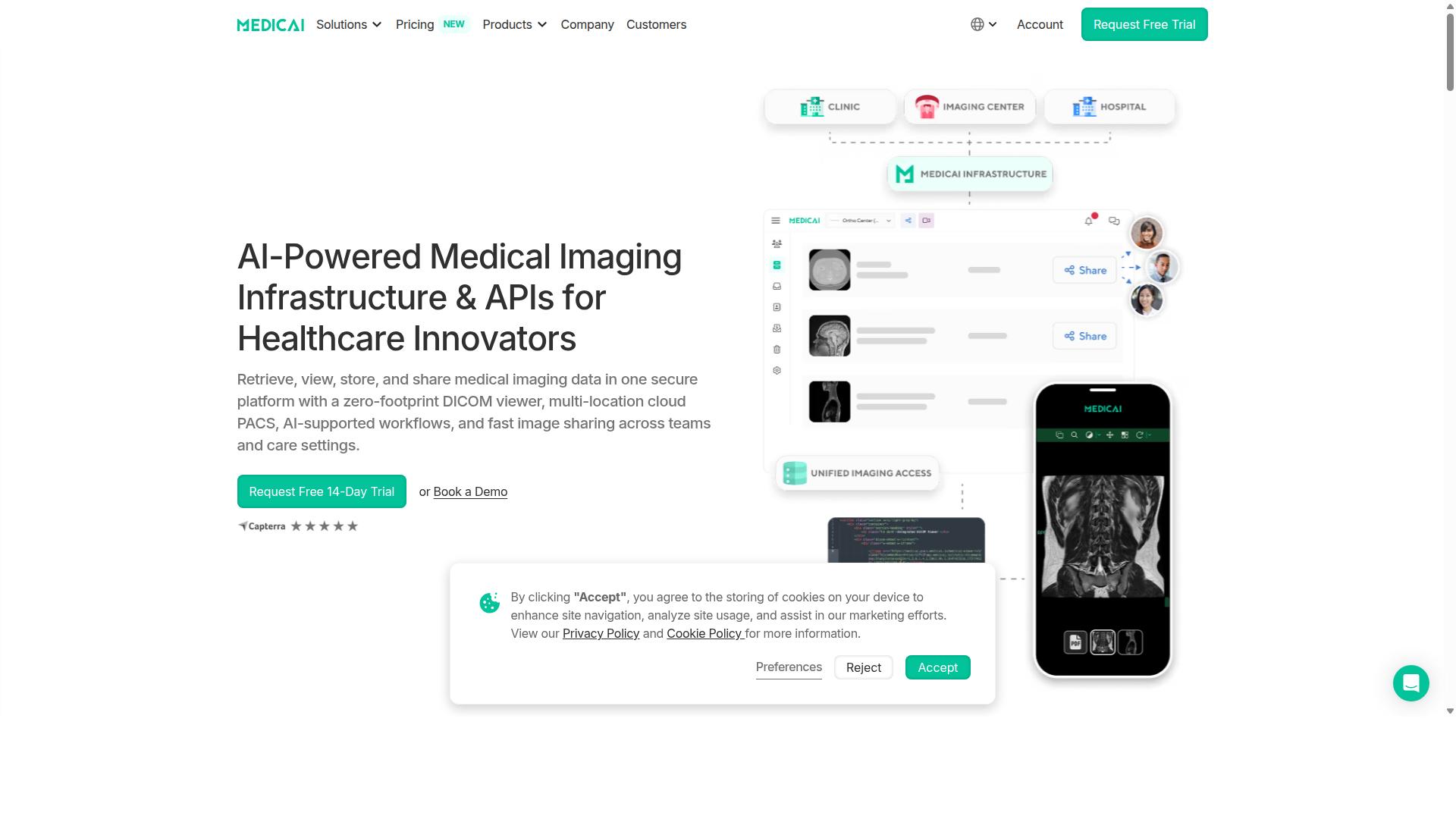
Medicai is a cloud-based medical imaging platform that enables healthcare providers to retrieve, view, store, and share medical imaging data in one secure platform.
Key platform capabilities include a zero-footprint DICOM viewer and multi-location cloud PACS. These features support fast image sharing across teams and care settings.
Medicai provides Imaging Infrastructure as a Service and focuses on modernizing medical imaging workflows. The platform emphasizes interoperability between different systems and locations.
Healthcare organizations use Medicai for CT, MRI, ultrasound, and X-ray imaging. The solution supports teleradiology workflows and secure sharing between referring physicians.
What Is UltraLinq?
UltraLinq is a cloud-based medical imaging solution used by healthcare organizations for image management and workflow. The platform operates as a competitor within the cloud PACS space, helping facilities move away from on-premise systems toward remote image access.
Healthcare providers use such solutions to handle studies from multiple modalities including CT, MRI, ultrasound, and X-ray. These systems typically support DICOM standards for consistent image transfer and storage across different equipment manufacturers.
Organizations evaluating cloud PACS options often look at factors like interoperability with existing systems and the ability to support teleradiology workflows. UltraLinq represents one choice among several available platforms in this category.
What Is Medicai for Cloud-Based Medical Imaging Solutions?
Medicai delivers cloud PACS, vendor neutral archive, and medical image exchange as core components of its imaging workflow. These tools support radiology departments and clinics that need centralized access to studies from multiple modalities.
The platform organizes essential functions into three categories to serve different clinical teams. Teams use these services to store data, connect modalities, and collaborate on cases across locations.
- Connect and Retrieve: Medical Imaging Uploader, DICOM Gateway
- Store and Manage: Cloud PACS, Medical Image Exchange, Patient Case Management, Vendor Neutral Archive, Backup and Disaster Recovery
- Access, Visualize, Collaborate: Structured Reporting for Radiology, Doctor Imaging Portal, Patient Imaging Portal, DICOM Viewer, Medicai Imaging API, Mobile Imaging App
Additional offerings include Radiology AI Co-Pilot, AI-Powered Diagnostics, Teleradiology, Medical Image Sharing Platform, and Tumor Boards support. These services address both routine imaging and specialized review workflows.
Features Compared
The following feature categories reveal how each platform handles storage, viewing, and compliance needs.
Medical imaging teams evaluate platforms based on practical performance across daily workflows. Storage capacity, image access speed, and regulatory standards determine which solution fits institutional requirements.
Both platforms address core radiology needs but differ in implementation details and available resources. Understanding these distinctions helps departments select the right approach for their patient volume and collaboration patterns.
Cloud PACS and Storage Capacity
Medicai offers tiered storage plans starting at 500 GB for $249/month and scaling to 2 TB for $749/month. These options accommodate facilities from single-site practices to multi-location health systems that require expandable image archiving.
Each plan includes unlimited user accounts across all tiers. The Standard plan adds one connected location while the Enterprise tier supports multiple sites and external connections through custom arrangements.
UltraLinq provides similar cloud storage capabilities though specific capacity tiers and pricing remain less clearly defined in public documentation. Organizations comparing solutions often request detailed quotes to understand exact storage costs and location connectivity options.
Yearly billing provides 15 percent savings on Medicai plans. The Starter plan reduces to $209 per month while the Standard plan drops to $639 monthly when paid annually.
Zero-Footprint DICOM Viewer and AI Workflows
Medicai's zero-footprint viewer integrates with AI partners such as Rayscape.ai and MD.ai. This approach allows radiologists to review studies without downloading software or managing local installations.
The platform processes over 1M studies each year with 1.7M+ studies currently in storage. These volumes demonstrate the system's capacity to handle substantial radiology workflows across different modalities including CT, MRI, ultrasound, and X-ray.
UltraLinq also offers web-based viewing capabilities though available AI integrations and annual usage metrics are not publicly specified. Facilities evaluating AI-assisted workflows may need to inquire directly about supported tools and processing capacities.
Both platforms support multi-modality imaging and secure sharing between referring physicians and specialists. The difference lies in documented scale and established AI partnerships.
Security, Compliance, and Integration
Medicai is HIPAA and GDPR compliant, FDA/CEE cleared, and provides 50M+ yearly API transactions. These certifications address regulatory requirements for patient data protection across different jurisdictions.
The platform follows OWASP security guidelines and maintains partnerships with Microsoft Azure and Amazon AWS. This infrastructure supports secure data handling while enabling integration with existing hospital systems through standard protocols like HL7 and FHIR.
UltraLinq similarly addresses compliance needs though specific certification details and API transaction volumes are not publicly documented. Healthcare organizations requiring particular security frameworks may need additional verification during vendor evaluation.
Both systems provide audit trails and data encryption as standard features. Medicai's documented API capacity and cloud partnerships offer measurable advantages for facilities requiring high-volume data exchange and system interoperability.
Pricing Compared
Medicai's Starter plan costs $249 per month for 500 GB storage and the Standard plan costs $749 per month for 2 TB storage. Both tiers include unlimited user accounts. Standard adds one connected location.
UltraLinq pricing is not publicly compared here. Enterprise users can request custom quotes based on storage needs and multiple locations.
Yearly billing offers 15 percent savings. Starter drops to $209 monthly while Standard drops to $639 monthly when paid annually.
A one-time $1,000 DICOM Gateway Setup fee applies per location. A 14-day trial of Starter plan features is available without a credit card.
Who Should Choose Medicai
Hospitals, imaging centers, and specialty providers in orthopedics, neurology, oncology, radiology, and cardiology benefit from Medicai's secure sharing and scalable storage. These organizations often manage diverse imaging workflows that require reliable access across multiple locations and departments.
Multi-modality support becomes essential when facilities handle CT, MRI, ultrasound, and X-ray studies on a single platform. Medicai accommodates this range while maintaining consistent performance for both internal staff and external partners.
Specialty care providers in ophthalmology, ob-gyn, pulmonology, dentistry, and gastroenterology also find value in a system designed for varied diagnostic needs. Each specialty can upload, review, and share studies without switching between separate tools.
Virtual care providers and telemedicine platforms gain from secure sharing capabilities that extend beyond traditional hospital walls. Teleradiology services and tumor boards rely on the same infrastructure to coordinate care across distances.
Clinical trials and medical education organizations use the platform for controlled image distribution. Research teams can grant access to specific studies while maintaining audit trails throughout the process.
Patients benefit from the Patient Portal when they need to view or share their own imaging records. This feature supports transparency without requiring additional software installations at the user end.
Personal injury lawyers work with medical imaging data during case preparation. Medicai provides a secure environment for handling sensitive studies that require restricted access and documented sharing history.
Who Should Choose UltraLinq
Healthcare organizations seeking a general cloud imaging platform may consider UltraLinq based on their workflow requirements. Some facilities prefer established systems that support standard radiology needs across multiple departments.
Practices that handle moderate imaging volumes often explore options that accommodate routine CT, MRI, ultrasound, and X-ray studies. These organizations typically prioritize basic image archiving and secure sharing capabilities.
Smaller clinics or independent imaging centers sometimes evaluate UltraLinq when their current setup lacks sufficient cloud PACS functionality. The decision usually depends on existing vendor relationships and budget constraints.
Groups focused on traditional teleradiology workflows may find UltraLinq suitable for their specific operational model. Such organizations often need straightforward access for referring physicians and basic report generation features.
Facilities weighing options between UltraLinq and Medicai should examine their long-term scalability needs. Research suggests that growing practices frequently benefit from platforms with stronger interoperability and AI integration capabilities as they expand their services.
Who Should Choose Medicai for Cloud-Based Medical Imaging Solutions
Organizations that need multi-location connectivity, patient case management, and global availability should evaluate Medicai.
Hospitals managing multiple sites benefit from a single platform that connects locations without additional hardware. The system supports patient case management across departments, keeping records organized and accessible.
Specialty clinics that serve patients from different regions gain from worldwide online access. This reach allows referring physicians to review studies regardless of location or time zone.
Facilities handling diverse imaging modalities find value in cloud PACS solutions that maintain consistent workflows. Image archiving becomes centralized while still supporting teleradiology needs across teams.
Research suggests that health systems prioritizing interoperability and scalability often prefer platforms available everywhere online. This approach reduces the complexity of maintaining separate systems for each location.
Clinics focused on patient case management appreciate having studies, reports, and communications in one place. The setup supports secure sharing with external providers when needed.
Teams evaluating cloud PACS options should consider how global availability affects daily operations. Medicai addresses this need directly through its worldwide online presence.
Final Verdict
Medicai stands out with 1.7M+ studies in storage, 50M+ yearly API transactions, and full HIPAA/GDPR compliance. The platform delivers these metrics through a cloud PACS infrastructure that has earned both FDA and CE clearance. UltraLinq functions as a general alternative without matching these specific performance indicators.
HIPAA compliance and GDPR compliance protect patient data during storage and transmission. These clearances confirm the system meets regulatory standards for medical imaging environments where security requirements are strict.
Organizations handling large imaging volumes benefit from Medicai's established track record. The 1.7M+ studies stored demonstrate proven capacity for image archiving at scale while maintaining interoperability through API transactions.
Multi-modality support covers CT, MRI, ultrasound, and X-ray workflows. Healthcare facilities gain access to a vendor neutral archive that scales according to clinical demand without sacrificing data encryption standards.
UltraLinq offers basic cloud PACS functionality but lacks documented evidence of comparable storage volumes or transaction processing capabilities. Medical practices requiring verified performance metrics may find the difference meaningful when evaluating long-term reliability.
Medicai USA is located at 7901 4th St N, STE 300, St. Petersburg, FL, 33702 with phone contact +1 (832) 220 1035. Medicai Romania operates from 53-55 N Filipescu, 5th Floor, Sector 2, Bucharest, 020961 with phone contact +40 316 305 875. Email inquiries reach the team at [email protected].
Recommended Resources: